

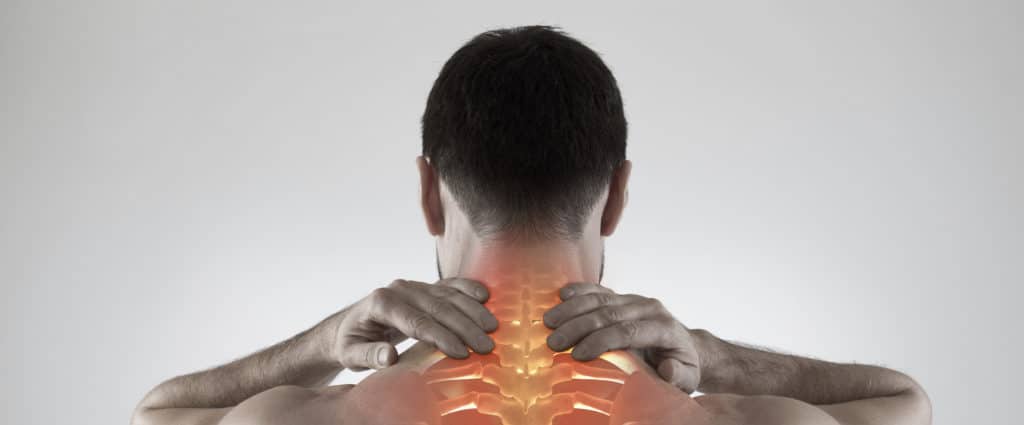
When a disc in your neck herniates, the disc material can place pressure on the nerves in the area. This can lead to serious neck pain that often radiates out to the arms and into the hands. Beyond the pain, this nerve impingement can lead to loss of function in the arms and hands. Dr. Albert performs cervical disc arthroplasty in these situations. As part of the procedure, he will remove the herniated disc and replace it with an artificial disc, eliminating the pain and returning function.
What Is Cervical Disc Arthroplasty?
Cervical disc arthroplasty also is known as a cervical disc replacement is a type of joint replacement procedure that involves removing the damaged natural cervical disc and replacing it with an artificial cervical disc. The goal of the procedure is to eliminate the pressure being placed on the nerve root by the herniated disc without losing mobility in the neck.
In the past, before the development of artificial discs, the typical procedure in these cases was to remove the damaged disc and fuse the two vertebrae together. While this procedure usually eliminates the pain, it also decreases mobility.
As an alternative to spinal fusion, artificial discs have been developed that maintain motion in the treated vertebral segment. An artificial cervical disc functions like a joint, allowing for flexion, extension, side bending, and rotation.
Where Are The Cervical Discs Located?
The cervical vertebrae of the spine consist of the seven vertebrae that make up the neck, running from the base of the skull and ending at the thoracic vertebrae in the trunk. Of the entire spinal column, the cervical vertebrae are the thinnest and most delicate bones. The cervical vertebrae are numbered C1-C7.
What Is A Herniated Disc?
The problems arise with the discs between the cervical vertebrae. The discs are the rubbery cushions that keep the bones apart. Discs have a softer gel in the interior encased in a tough outer skin. Sometimes a disc can become damaged — maybe from arthritis or just everyday wear-and-tear — causing a tear to develop in the outer skin, allowing the inner gel to push outward. When the gel pushes on an adjacent nerve it results in pain, numbness, or weakness in the neck and out into the arms and hands. A bone spur can also push on the nerve. Over time, this compression of the nerves can result in nerve death and loss of function in the extremity.
Cervical Disc Replacement (CDR) Candidates In NYC
Ninety percent of neck pain cases, even with disc herniation, resolve themselves with some time and nonsurgical treatment. But in one in 10 cases, the damaged disc or bone spur is causing serious impingement of the nerve, and it can’t be corrected without surgery. Generally, to be considered for the disc replacement, a patient must have a symptomatic cervical disc, which may be causing arm pain, arm weakness or numbness, and some degree of neck pain. These symptoms may be the result of a herniated disc and/or bone spurs that are compressing adjacent nerves or the spinal cord.
These are the usual criteria for this surgery:
- Significant neck pain and/or pain that radiates into the upper extremities
- No significant response to nonsurgical treatment such as anti-inflammatory medications, physical therapy, or epidural injections.
- You have no prior neck surgery at the level of the herniation
- No osteoporosis
- No facet joint arthritis in the cervical spine
- You do not suffer from neck instability
Preparing For Your Cervical Disc Arthroplasty Surgery
We ask that you refrain from taking any nonsteroidal anti-inflammatory medicines 10 days before your surgery:
- Aspirin
- Advil
- Aleve
- Herbal supplements
- Vitamins E & K
- fish oil
You can resume taking these medications after surgery. If you have a physician who recommends that you do not stop Aspirin prior to surgery please be sure to discuss this with our office. You should discontinue all exposure to nicotine, as well as nicotine-containing products, two weeks before and at least 6 weeks after your surgery.
The Cervical Disc Replacement Procedure
Dr. Albert begins this surgery by making a one to the two-inch incision in the front of the neck. The thin muscle that is just under the skin is cut and moved aside, and the tissue that surrounds the spine is removed in the area. Next, the damaged disc is removed. In some cases, some of the outer membranes may be left in place.
With the damaged disc removed, the next step is to re-establish the proper spacing between the two vertebrae. As the disc flattens and pushes outward, the vertebrae usually become too close, also creating pressure on the nerve roots. Plus, increasing space makes room for the prosthetic disc. Dr. Albert then uses x-rays to guide him as he places the artificial disc into place between the vertebrae. He attaches it, usually with screws, then reorients the tissues and closes the incision.
Is The Cervical Disc Surgery Painful?
Please keep in mind that pain is a very subjective experience and one’s reaction to surgery is affected by a variety of factors as mentioned above. The most common concerns we hear from patients after artificial cervical disc surgery are related to a sore throat (similar to after a tonsillectomy) and discomfort around their scapula (or shoulder blade). Both of these tend to resolve prior to the first post-operative appointment at 2-3 weeks after surgery.
It is not uncommon for patients to experience “reminder” pain after surgery. This is when a patient begins to experience the same symptoms as they had before surgery. While this is common in recovery from spine surgery we understand that this can be very concerning to our patients. We encourage you to call the office with any concerns you may have after surgery.
Although the FDA only approved the first artificial disc, the Prestige Cervical disc, in 2007, there have been several new artificial discs developed since then. Dr. Albert will discuss all of your options with you.
Cervical Disc Arthroplasty Patient Testimonial
"Dr. Albert is the best doctor I’ve ever encountered he did what he said he was going to do I had two Surgeries cervical spine and also lower spine opening up stenosis, he has the best manners very compassionate and did what he said he was going to do the first time ever a doctor ever did that for me well worth the drive from Connecticut which is a pain in the a– but would do it again in a heartbeat the best results ever the best doctor ever."
"I was in a car accident over 2 years ago. I had 3 opions . I had an appointment with Dr Todd Albert from HSS hospital he took his time explaining everything to me but wanted me to take some more tests he was very thorough. I was in excruciating pain. My left hand was totally numb my neck was in pain and both my arms were in a lot of pain.. I was so afraid to have cervical spine surgery. Fusion 4-7 Im so happy. I went through with the surgery. Thank you Dr Albert for giving me my life back!"
Click here to view more patient testimonials.
Recovery From Cervical Disc Replacement Surgery
For the first 2-3 weeks, your activity will be limited to walking. We encourage you to walk as much as you are comfortable. During this time you may go up and downstairs, with the use of a railing, and you may also sleep in a normal bed. You will be limited to lifting 5 pounds for the first 2 weeks. After two weeks you will be able to resume low-impact cardiovascular activities and increase the amount of weight you are lifting. Within a reasonable amount of time after surgery, you will have very few restrictions on your activities. Please be sure to discuss any specific questions with us in the office.
The first visit is 2-3 weeks after surgery however if you have any questions or concerns please call our office in NYC. If we think we should see you in the office sooner rather than later, we will schedule an earlier appointment. Most patients do not have sutures that need to be removed after a cervical disc arthroplasty surgery. There are internal sutures that will dissolve with time. There will also be steri-strips (white pieces of tape) over the incision that will either fall off or we will remove them from the office.
Please keep in mind that the recovery from surgery is quite subjective and is affected by various factors such as patient age, comorbid illnesses, the degree of the spinal cord or nerve impingement, the length of illness prior to surgery as well as the degree of disability prior to surgery to name a few. We will provide you with isometric neck strengthening exercises that can be performed independently. If you are experiencing any motor weakness or balance changes before surgery we will likely recommend outpatient physical therapy after surgery.
What Are The Risks Of Cervical Disc Surgery?
Because artificial cervical discs are relatively new, their long-term durability is unknown. Currently, after around five years, 3-4 percent of patients who have undergone cervical disc replacement have needed repeat surgery. This is a similar number to those who have a total hip replacement. There is some thinking that because the neck vertebrae bear so much less weight than artificial hips or knees that artificial cervical discs should have a longer lifespan.
There are other typical risks with surgery: infection, blood loss, nerve injury, reactions to anesthesia, and spinal fluid leak. In some cases, there can also be a change of voice and difficulty swallowing or breathing, but these are very rare.

When Does Dr. Albert Suggest Cervical Disc Replacement?
Cervical disc replacement is not appropriate for every patient, which is why experience and careful judgment are critical when considering this procedure. Dr. Albert prefers cervical disc replacement when anatomy, alignment, and pathology allow because it addresses nerve compression while preserving the natural mechanics of the cervical spine. His approach emphasizes long-term spinal health instead of short-term symptom relief.
With extensive experience in both fusion and motion-preserving cervical procedures, Dr. Albert evaluates each case individually using advanced imaging and neurological assessment. When disc replacement is appropriate, it allows you to maintain neck mobility while reducing stress on adjacent spinal levels. This thoughtful, conservative approach reflects Dr. Albert’s commitment to offering the most appropriate (not simply the most available) surgical solution.
Cervical Disc Replacement vs. Fusion: Long-Term Considerations
Both cervical disc replacement and spinal fusion are effective procedures for relieving nerve compression caused by herniated discs or bone spurs. The key difference lies in how each procedure affects motion. Fusion permanently stabilizes the treated segment, while cervical disc replacement maintains movement at that level.
Preserving motion can help you maintain more natural biomechanics of the cervical spine. Over time, fused segments may transfer additional stress to nearby discs, which potentially contributes to degeneration at adjacent levels. Cervical disc replacement is designed to reduce this effect by allowing continued flexion, extension, rotation, and side bending.
Dr. Albert considers factors such as spinal alignment, facet joint health, bone quality, and the number of affected levels before recommending either option. Fusion remains the preferred choice in certain cases, and disc replacement is recommended only when it offers a clear advantage for long-term function and stability.
How Motion Preservation Protects Adjacent Spinal Levels
One of the primary benefits of cervical disc replacement is its ability to preserve motion at the treated spinal segment. Maintaining this movement helps you distribute forces more evenly across your cervical spine during daily activities such as turning your head, looking up or down, and maintaining posture.
By reducing excess stress on surrounding discs, motion preservation may help protect adjacent spinal levels from accelerated wear. This can be particularly important for younger or more active individuals who place greater functional demands on their neck. While no procedure can stop natural aging, preserving normal biomechanics supports healthier movement patterns over time.
Dr. Albert’s surgical planning prioritizes spinal balance and alignment, ensuring the artificial disc functions as naturally as possible within the cervical spine.
Long-Term Outlook After Cervical Disc Replacement Surgery
Cervical disc replacement is designed to provide durable relief from nerve-related symptoms like numbness and arm pain while supporting ongoing neck mobility. Long-term follow-up focuses on maintaining spinal health through activity modification, posture awareness, and regular monitoring when appropriate.
Why Choose Dr. Todd J. Albert for Cervical Disc Replacement Surgery?
Dr. Albert is a board-certified orthopedic spine surgeon with decades of experience treating complex cervical spine conditions. Known nationally for his expertise, he combines advanced surgical technique with careful patient selection to deliver safe, effective outcomes.
His commitment to motion-preserving surgery, individualized treatment planning, and attentive follow-up care allows you to move forward with confidence, knowing your spine health is being managed with precision and integrity in New York City.
Cervical Disk Arthroplasty FAQs
How Long Will I Be Wearing The Soft Collar After My Disc Replacement?
The average amount of time patients wear the collar after cervical disc arthroplasty surgery is 2-3 weeks.
Will I Set Off Metal Detectors After My Cervical Disc Arthroplasty?
No, the titanium instrumentation does not currently set off metal detectors.
Will I Be Able To Have I Have An MRI After Cervical Disc Replacement Surgery?
Yes, disc replacement does not react to the magnet in the MRI machine however you should still notify the MRI facility that you had this type of surgery.
When Will I Be Able To Drive After My Disc Arthroplasty Surgery?
Most patients are able to begin driving, short distances, between 2-3 weeks after surgery. You may be a passenger in a car as soon as you feel up to it.
When Can I Return To Work After My Cervical Disc Replacement Surgery?
The average length of time out of work after a CDR surgery is between 2-3 weeks. Patients who perform labor-intense jobs are more likely to be out of work closer to 4 weeks.
Schedule An Appointment
For more information on Cervical Disc Arthroplasty surgery, call 212-606-1004 to schedule a consultation with New York City Spine Surgeon, Dr. Todd J. Albert.